Everything on Veilid has an address, and every address
looks like VLD0:6gds2Sha9LzuLpKxiQlSJ7e5KO7BPZ4iWK4Nne1MhvZ. That's fine for
software and terrible for people. You can't read one aloud, you can't remember
one, and you can't tell at a glance whether a link is the one you meant to
click.
VNS, the Veilid Name System, fixes that. It lets you publish a name such as
blog.wrew.vns that points to a CypherPage site, any Veilid record, a private
route, or a short piece of text. It works like DNS, but there is no central
server, no registrar database, and no company that can suspend your name. The
names live on Veilid itself, and only the owner's key can change them.
I designed and built it end to end: the spec, the Rust library, the vns
command-line tool, a local web console, the registrar that hands out top-level
names, and the default root that's running on the network today.
What it does
Names you actually own. Names live in zones. A zone is a Veilid record that only its owner's key can write, and the zone's public key is its identity. There's no account and no sign-up. Make a zone, and it's yours:
vns zone new --nickname wrew          # create a zone you own
vns register wrew wrew                # claim wrew.vns
vns set wrew blog site 'VLD0:...'     # blog.wrew.vns -> a CypherPage site
vns serve                             # keep your zones on the network
vns resolve blog.wrew.vns             # look a name up
Delegation, like DNS. A zone can hand a label to another zone. Once
wrew.vns belongs to my zone, I can give friends.wrew.vns to someone else's
zone, and from then on they set everything under it and I can't touch it.
Lookups walk the name from right to left, one label at a time, exactly the way
DNS does.
Points at anything on Veilid. A name can lead to a CypherPage site, a DHT record, a private route, a short text, an alias for another name, or another zone.
Claim a top-level name. A root zone can run a registrar that hands out
unused top-level names, first come, first served. You ask for one with
vns register. The request is signed with your zone's key, which proves you own
the zone, and it travels to the registrar over a Veilid private route rather
than to a web server. The registrar delegates the name to
your zone and gets out of the way. There are guardrails: three names per zone
per root, a reserved list (www, admin, and friends), and rate limits.
Registrars can also charge a yearly fee through Stripe, with expiry, a 30-day
grace period, renewals, and reminders built in.
You choose who to trust. Every lookup starts at a trust anchor, and you
decide what those are. First come your own petnames ("when I say alice, I
mean this zone"), then any roots you've added, then the default root, which you
can turn off. If you don't like how a root runs things, you can ignore it
without asking anyone's permission.
A root that can survive losing its key. If the software had the default
root's key built in, a stolen key would mean losing .vns for every user,
forever. So clients don't trust the root directly. They trust a small
pointer zone whose only job is to name the current root, and the pointer's
key never touches a server: it lives offline in an encrypted vault. If the
root's key is ever lost or stolen, I restore the names from a snapshot into a
new root, move the pointer, and every client follows within five minutes.
Stays up when the owner is offline. Here's something I learned by reading
Veilid's storage code: storage nodes quietly drop records nobody re-sends, and
nothing re-sends them on a schedule. So vns serve reopens your zones every 30
minutes, which makes Veilid check the network and push back anything that went
missing. Anyone can also mirror a zone they care about to keep it reachable
while its owner is away. Every value carries the owner's signature, so a mirror
can keep a zone alive but can never change it.
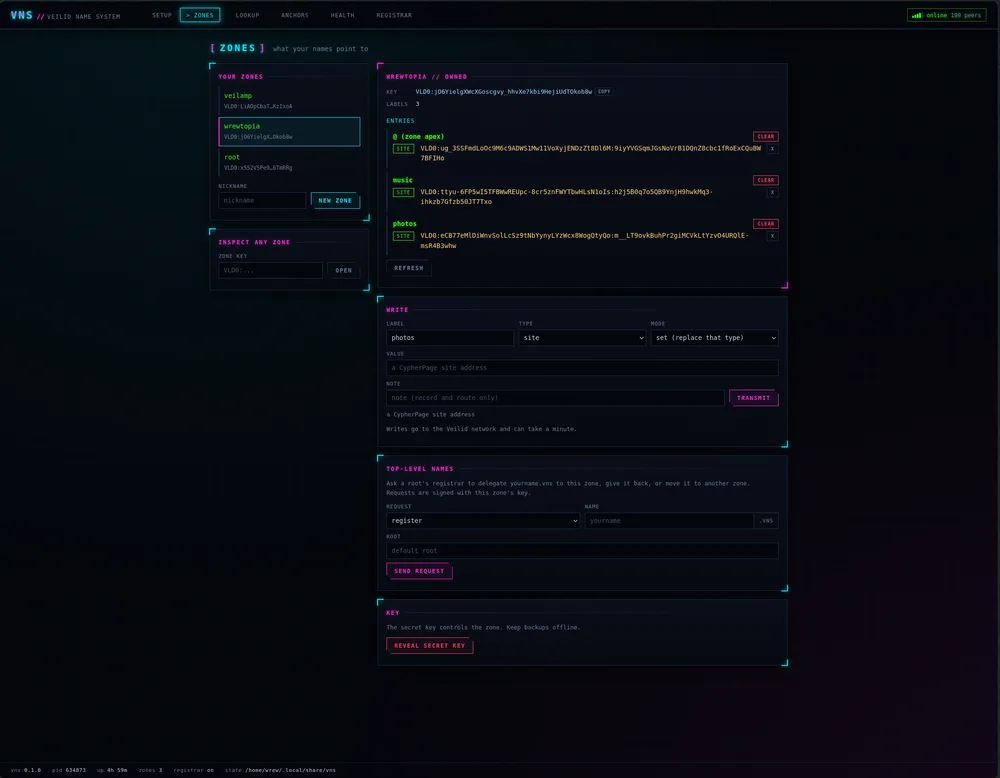
A console for people who don't live in a terminal. vns ui opens a local
web console with a setup checklist (make a zone, claim a name, back up your
keys, install the service), a zone editor, lookups that show every hop, trust
anchors, node health, mirrors, and registrar administration. It listens only on
127.0.0.1, needs a one-time login code, and refuses requests from other sites.
Built into the browser. My desktop browser, Scrim, resolves .vns names
natively, so typing veilamp.vns in the address bar opens Veilamp's site straight off Veilid. Every program on the computer that
uses VNS shares the same trust anchors, so a petname you set once works
everywhere.
Under the hood
VNS is a Rust library and command-line tool built on veilid-core. The format
and the lookup rules are written down in a spec, so other software can
implement it without reading my code.
- Zones: a zone is one Veilid DHT record with 64 subkeys, called buckets. A label's bucket comes from a BLAKE3 hash of the label, so reading a name means fetching one small bucket, not the whole zone.
- Growing without a ceiling: a bucket holds 16 KB. When a change would push one past 75% full, its labels move into a child record and the bucket keeps a pointer to it. Child keys are derived from the zone's key, so one backup covers everything. Splits stop at depth 3, so any name takes at most four reads.
- Lookups: answers are cached for five minutes (one minute for names that don't exist). If the network can't be reached, VNS falls back to the copy Veilid stored locally and marks the answer as stale instead of failing.
- Registrar: a long-running service that publishes a private route in the root, answers signed requests, enforces the rules, and, when charging is on, checks Stripe for completed payments and keeps every name's expiry in a status zone derived from the root key. A standby host holds a copy of the key; in a failover drill it took over in about 45 seconds with every name intact.
- Monitoring: a scheduled CI job checks the root from the outside (the pointer, the registrar, a test lookup, how full the buckets are), saves a snapshot of every name, and pings my phone through ntfy if anything looks wrong.
- Security model: Veilid signs and verifies every value, so storage nodes can't forge names. They can hold back a newer value, so applications should remember answers and say when a name starts pointing somewhere new. Looking up a name does tell the nodes you ask which zones you're reading, and naming a site publishes its read key, so don't name things you meant to keep private.
- Testing: about 100 tests, from the offline resolver and bucket-splitting logic up to live tests that spin up two or three real Veilid nodes and run registrations, mirrors, and a full root-key rotation on the actual network.
Status
_VNS is up and running: the default root is live, its registrar is answering,
and veilamp.vns resolves today. The source isn't public yet. If you want to
try it, run a mirror, or run a root of your own, get in touch through the
VNS page on Wrewtopia Labs